
23 September 2026
Every Tool We Run On, and What It Costs

We drew a map of everything SpareHand AI runs on. Every tool, what it does, roughly what it costs. It's here if you want to look at it first.
Six branches, twenty-three tools, eight live n8n workflows, and about A$200 a month across the lot.
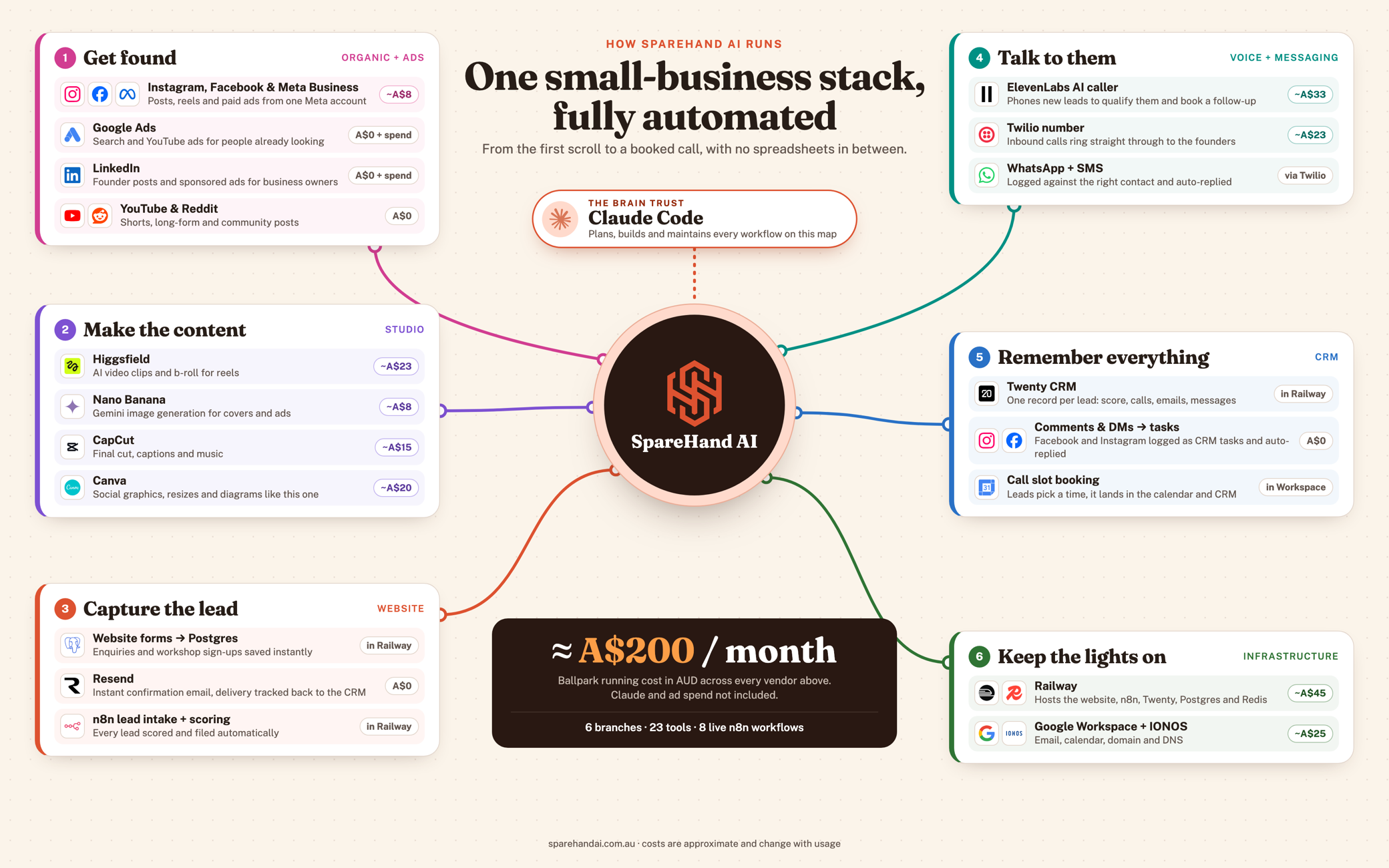
We're publishing it for a slightly self-interested reason. People ask what an automated business actually costs to run, and the honest answer is "less than you think, but not nothing, and the tools aren't the hard part." A map makes that easier to show than to argue.
What's on it
1. Get found
Instagram, Facebook and Meta ads out of one Meta account. Google Ads for people already searching. LinkedIn for founder posts. YouTube and Reddit for anything longer.
Only Meta costs us anything at rest, around A$8 a month. The rest is free to hold and only costs when we spend.
2. Make the content
Higgsfield for AI video clips and b-roll. Nano Banana for image generation. CapCut for the final cut and captions. Canva for social graphics, resizes, and the stack map itself.
About A$66 a month between them. This is the branch we'd cut first if money got tight, and the one we'd have said was optional a year ago. It isn't. Three of those four are doing work a person used to do.
3. Capture the lead
Website forms write straight to Postgres. Resend sends the confirmation email and reports delivery back to the CRM, so a bounce becomes a signal instead of silence. n8n scores every lead and files it.
Resend is free at our volume. Postgres and n8n ride along on Railway, which we pay for once in branch six.
4. Talk to them
An ElevenLabs agent phones new leads to qualify them and book a follow-up. A Twilio number rings the founders directly for inbound calls. WhatsApp and SMS land against the right contact automatically.
Around A$56 a month combined. This is the branch that took the longest to build and the one we wrote up separately, because almost none of the difficulty was the AI.
5. Remember everything
Twenty CRM holds one record per lead: the score, the calls, the emails, the messages. Facebook and Instagram comments and DMs arrive as tasks against that record. Leads pick their own call time and it lands in the calendar and the CRM together.
No line item. Twenty is self-hosted on the Railway bill.
6. Keep the lights on
Railway hosts the website, n8n, Twenty, Postgres and Redis for about A$45. Google Workspace and IONOS cover email, calendar, domain and DNS for about A$25.
A$70 of the A$200 is just having somewhere for the rest to live.
What the number doesn't include
Two things, and they're the two that matter.
Claude isn't in it. Claude Code plans, builds and maintains every workflow on that map. It sits at the top as its own box because it isn't a branch, it's the thing that built the branches. Leaving its cost out of a A$200 figure would be convenient and dishonest, so: it's a separate subscription, and it's the single most useful line item we pay for.
Ad spend isn't in it either. Google Ads and LinkedIn show A$0 plus spend for a reason. Holding the account is free. Whether you spend A$50 or A$5,000 has nothing to do with the stack.
So A$200 is the cost of the machinery, not the cost of running a business. Anyone quoting you a number that includes their ad budget is selling you something.
Two things on the map aren't finished
The auto-replies. Comments, DMs, WhatsApp and SMS all land in the CRM correctly today, and a human answers them. The map says "auto-reply in build" in two places because that's true, and we'd rather show it than quietly leave it off.
We're in no rush on that one. A canned reply buys a few hours and spends your first impression to do it. We'd rather it said something true or nothing at all.
What we'd tell someone copying this
The tools are the cheap part
A$200 a month is less than one afternoon of contractor time. Every hour we spent this year went into the joins: webhooks, field types, subscriptions, the places two systems each think the other is handling it. None of that shows up on a map.
Start with branch three
Capturing the lead and not losing it is worth more than everything else on here combined. If you do nothing else, get every enquiry landing in one place. We wrote about why.
Self-hosting moves cost, it doesn't remove it
Twenty and n8n are both free as software and both appear as A$0 on the map. They are not free. They're inside that A$45 Railway line, along with the time we spend when a deploy misbehaves. That trade has been worth it for us. It is not automatically worth it for you.
Six branches is more than you need
We run content production because we're marketing a business that sells automation, so our own funnel has to look like it works. A plumber does not need Higgsfield. Cross branch two off and you're at about A$134 a month.
Why publish the costs at all
Because the alternative is a page saying "affordable" and a call where you find out what that means.
These numbers move. They're approximate, they're in AUD, and usage changes them month to month. But they're real, they're ours, and you can check every vendor's pricing page yourself in about ten minutes.
If you're weighing up whether this is worth doing, a stranger's actual bill is more use than another article about ROI.